Oddlet: Zheng He · 1 min read
May 21, 2026
The Admiral and the Unicorn
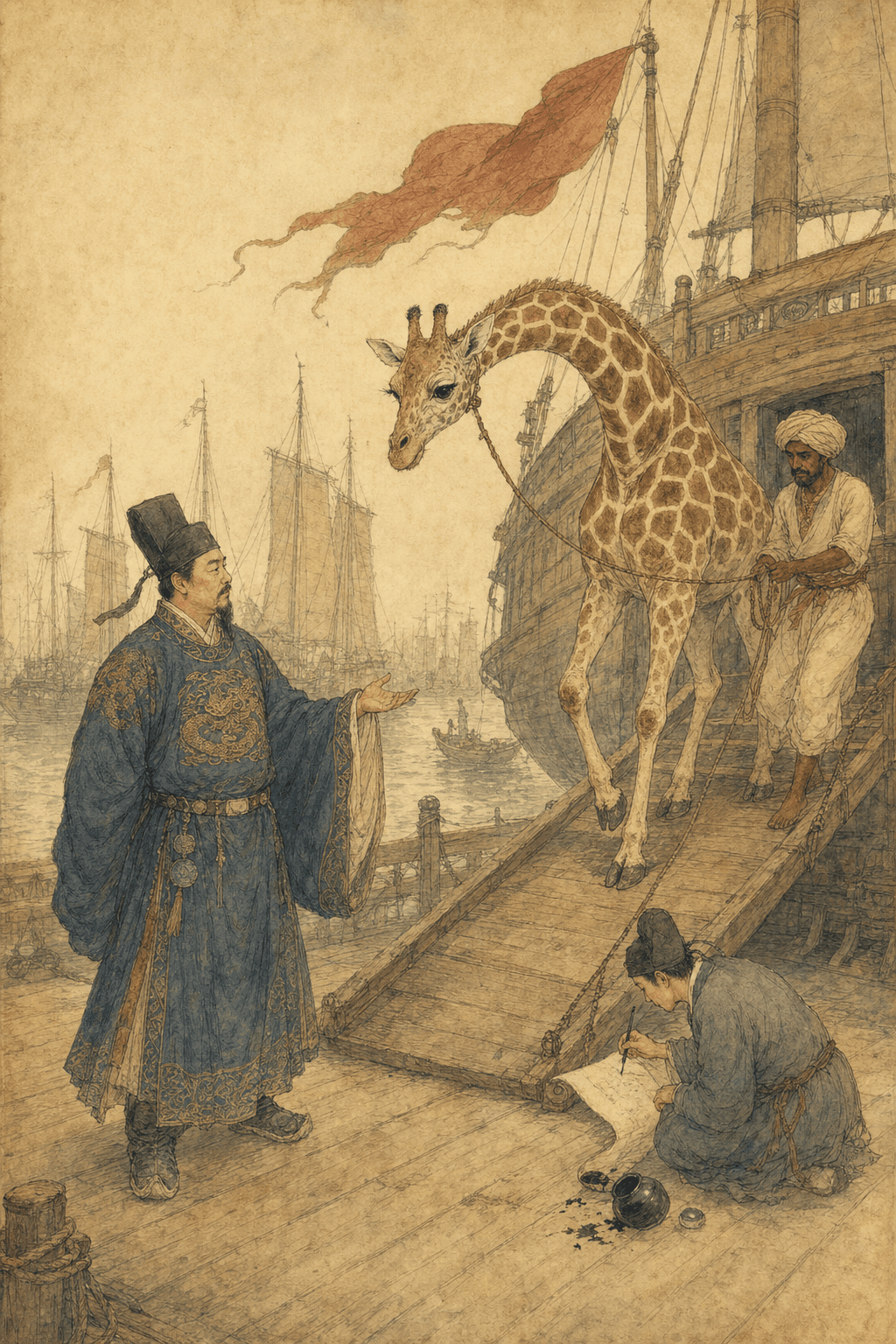
A giraffe walked into the Ming court in 1414, and the Confucian scholars decided it was proof from heaven.
Between 1405 and 1433, the eunuch admiral Zheng He commanded seven voyages across the Indian Ocean for the Yongle Emperor of Ming China. His first fleet carried 317 ships and 27,800 men. The largest of his treasure ships ran to at least 60 meters, possibly twice that, with nine masts, bamboo-inspired watertight bulkheads, 180 physicians, and mung beans sprouting on deck for vitamin C. Eighty-seven years later, Columbus crossed the Atlantic with three ships and ninety men.
Zheng He brought back a giraffe.
He brought back lions, leopards, ostriches, and zebras too, but the giraffe is the one that mattered. It arrived in 1414 from Malindi, by way of the Sultan of Bengal, and the Confucian court took one look at the long neck and the cloven hooves and declared it a qilin: a unicorn-like beast that appears only during the reign of a perfect sage-king. Yongle, who had taken the throne from his nephew twelve years earlier in a civil war, accepted this reading without visible difficulty. One imagines the giraffe accepted it too.
The fleets sailed for nineteen more years. Then a Ming bureaucrat named Liu Daxia found the voyage archives in 1477 and had them burned, to prevent future emperors from repeating the folly.
Somewhere off Calicut, Zheng He was buried at sea. His tomb in Nanjing holds only his hat.
Know someone who’d love this?
- Britannica - Zheng He — Authoritative biography. Confirms 1371 birth in Kunyang, Yunnan; capture and castration after Ming reconquest in 1381; rise under the Prince of Yan; conferral of surname Zheng by Yongle in 1404; seven voyages 1405-1433; first voyage with 62 large ships and 27,800 men; death at Calicut in 1433.
- Wikipedia - Zheng He — Detailed biographical synthesis with primary-source citations. Provides ancestry (descent from Sayyid Ajjal), father Ma Hajji, 1381 capture by Fu Youde, 1399 defense of Zhenglunba, 1404 surname conferral, fleet composition, ship dimensions per History of Ming, and the 1431 inscriptions.
- Wikipedia - Ming treasure voyages — Voyage-by-voyage chronology with dates: 1st (1405-07), 2nd (1407-09), 3rd (1409-11), 4th (1413-15), 5th (1417-19), 6th (1421-22), 7th (1430-33). Battle dates, captures of Alakeshvara (1411) and Sekandar (1415), and post-1435 dismantling.
- Wikipedia - Battle of Palembang (1407) — Documents 5,000 pirates killed, 10 ships destroyed and 7 captured at Palembang; informant Shi Jinqing; execution of Chen Zuyi in Nanjing on 2 October 1407.
- Wikipedia - Chinese treasure ship — Surveys the dispute over treasure ship dimensions: 44 zhang x 18 zhang in History of Ming traced to a 1597 novel; modern estimates of 52-76 m; the 11-meter rudder post unearthed at Nanjing's Longjiang Shipyard in 1957.

This Ain't an Egg-Shop
Who walks 130 miles through an Antarctic winter, in total darkness, to fetch a penguin egg?
The Cape Compromise
She swam thirteen miles down the Thames, twenty-two down the Danube, and got arrested walking onto a beach in Boston.
The Divine Sarah's Menagerie
What do you feed an alligator you keep in a Paris apartment above a bedroom draped in black velvet?
Wonder, delivered.
A fresh Oddlet in your inbox every morning, a full day before everyone else. True, strange and under a minute.
Free forever. Unsubscribe anytime.