People
The curious, forgotten, and extraordinary figures behind every oddlet.
🇦🇴Angola(1)
🇦🇺Australia(1)
🇦🇹Austria(5)

Empress Sissi (Elisabeth of Austria)
She walked ten hours a day, fenced twice some days, and kept gymnastic rings rigged in her bedroom doorway. At fifty-six she weighed 96 pounds and had been diagnosed with edema of hunger. Empress Elisabeth of Austria, the Hofburg's hungriest athlete.
Hedy Lamarr
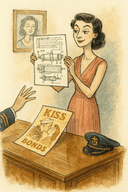
The Navy told Hedy Lamarr she'd be more useful selling kisses than inventing torpedo guidance systems.

Ida Pfeiffer
She slept beside drying human heads in Borneo and called her hosts good-natured. At fifty-five, she walked into Batak country with a line rehearsed in two languages. Ida Pfeiffer: Viennese widow, world traveler, connoisseur of tough flesh.
Kurt Gödel
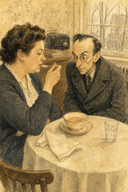
He wore a ski mask in Princeton. He threw out his bed. His wife tasted every spoonful for thirty-nine years. When she went to the hospital, he stopped eating. Kurt Gödel, the logician who proved no system is complete, built one anyway.
🇧🇪Belgium(2)
Joseph Plateau
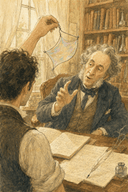
He stared at the noonday sun for 25 seconds to time the retina. He went blind. He kept working, dictating soap-film laws from angles his assistants called out from wire frames. Thirty years on, Joseph Plateau published. The man who saw with his ears.
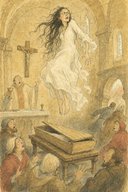
Saint Christina the Astonishing
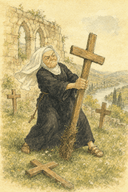
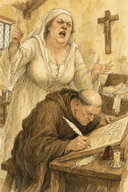
She climbed into bread ovens. She perched on gallows beside hanged thieves. She fled her own funeral for the church rafters because the mourners smelled of sin. Meet Christina of Sint-Truiden, the medieval shepherdess, patron saint of psychiatrists.
🇧🇷Brazil(1)
🇨🇦Canada(3)
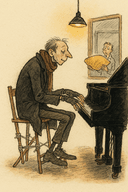
Glenn Gould
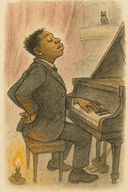
A folding chair, fourteen inches high, held together with duct tape and piano wire. The seat had worn clean through. From its bare frame came some of the most controlled recordings ever made. It now sits in a glass case in Canada. It belonged to Glenn Gould.
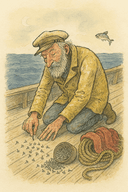
Joshua Slocum
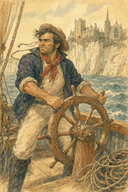
He rebuilt a rotting sloop for $553.62, navigated with a smashed tin clock, and scattered carpet tacks on deck to stop pirates while he slept. 46,000 miles of open ocean, alone. Joshua Slocum: the man the sea trusted back, until it didn't.

Maud Lewis
Tulips and oxen sold off the porch for two dollars. Butterflies on the stove door she cooked supper on. Forget-me-nots on the stair-risers. Painted hands curled into fists. Maud Lewis, of Marshalltown, Nova Scotia — folk painter.
🇨🇳China(1)
🇩🇰Denmark(2)
Hans Christian Andersen
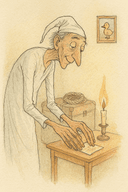
He carried a rope in his luggage in case his hotel caught fire. He left a note by his bed every night that read "I only appear to be dead." When planning his funeral, his only instruction about the music was that the tempo should suit little steps — because most of the mourners would be children. Hans Christian Andersen: the man who terrified the world into wonder, and spent his whole life quietly terrified.
Tycho Brahe
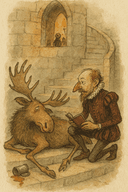
The greatest astronomer of the sixteenth century lost his nose in a duel over math, consulted a clairvoyant dwarf, and owned a moose that died falling down stairs drunk on beer.
🇪🇬Egypt(3)
Hypatia of Alexandria
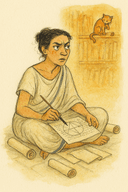
A math textbook edited around 364 AD quietly became the standard edition for fourteen centuries. Copernicus used it. Newton used it. Nobody noticed until 1808. The editor was Hypatia of Alexandria, last great scholar of the ancient world.
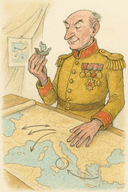
Ibrahim Pasha of Egypt
He took the fortress that defeated Napoleon. He destroyed two Ottoman armies. Four European powers formed an emergency coalition specifically to stop him from finishing the job. Ibrahim Pasha spent his life winning wars for his father — and held power for 113 days before his lungs gave out. The soldier who never lost a battle.
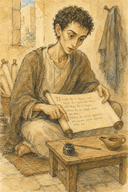
Origen
Six thousand works. One cloak, no shoes, the floor for a bed. A father lost to the executioner, a mother who hid the boy's clothes to keep him home. Then Origen of Alexandria read one verse in Matthew, and called the physician.
🇫🇮Finland(1)
🇫🇷France(22)

Alexandra David-Néel
She spoke Tibetan, had studied under Himalayan masters, and written books on Buddhist philosophy. None of it got her into Lhasa. So she blackened her face with soot, braided a yak-hair wig, and walked four months through winter mountain passes above 17,000 feet. Meet Alexandra David-Néel, the most ungovernable woman of the twentieth century.
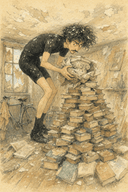
Alfred Jarry
The ceilings were 1.65 metres. He stuffed broken windows with newspaper, wore the whitewash that rubbed from above, and called his bicycle 'that which rolls.' At the centre, a stone phallus from Rops. Alfred Jarry lived around it for nine years.
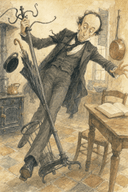
Charles-Valentin Alkan
He rented two apartments so no neighbour could hear him, wrote a symphony for one piano, and translated the entire Bible from three languages. Then Charles-Valentin Alkan vanished. For a century, no one knew how the great hermit of Paris died.
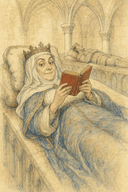
Eleanor of Aquitaine
🇫🇷France(1)
🇩🇪Germany(12)
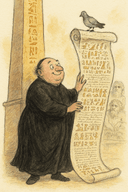
Athanasius Kircher
He proposed germ theory two centuries before Pasteur, built one of Europe's first public museums, and enjoyed the patronage of four popes. He was also wrong about nearly everything — including the hieroglyphics he had chiseled, in stone, into a fountain that still stands in Piazza Navona. Meet Athanasius Kircher: the most confident man in seventeenth-century Europe.

Bertha Benz
She cleaned the fuel line with a hat pin. She insulated a wire with her garter. She bought a pharmacy's entire stock of ligroin. Then a cobbler nailed leather to her brake blocks, inventing the brake pad. Meet Bertha Benz: history's first car thief.

Caroline Herschel
Four foot three. Pock-marked. Half-blind. Kept in the kitchen till twenty-two, told she would never marry. Then her brother discovered Uranus. Meet Caroline Herschel: cataloguer of 2,500 nebulae, finder of eight comets, dresser of her own wounds.
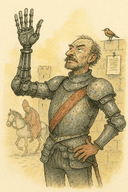
Götz von Berlichingen
🇬🇷Greece(5)
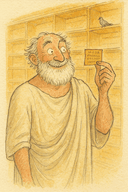
Democritus
He figured out that all matter is made of tiny indivisible particles moving through empty space. No lab, no instruments — just thinking. His neighbors thought he was insane and called a doctor. The doctor sided with him. Democritus: the man who got the universe right and left almost nothing behind.
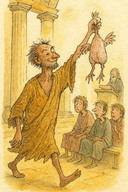
Diogenes of Sinope
Plato defined a human being as a featherless biped. His students found this clean, logical, elegant. Then someone plucked a chicken and walked into the lecture. The chicken won. Meet Diogenes of Sinope, the most committed philosopher who ever lived in a jar.
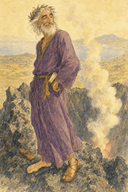
Empedocles
He stopped the etesian winds with flayed donkey skins. He redirected two rivers and ended a plague. He kept a woman breathless thirty days. Empedocles of Acragas dressed in purple and bronze, climbed Mount Etna, and jumped. It gave back one sandal.
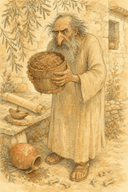
Heraclitus
🇭🇺Hungary(3)
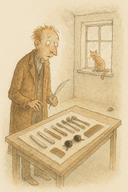
Comte de Saint-Germain
Spoke six languages, improved diamonds for a king, and claimed to be three hundred years old. His valet couldn’t confirm — only five hundred years of service. The Comte de Saint-Germain, most sought-after guest in Europe, was buried for free.
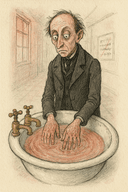
Ignaz Semmelweis
He died of the same infection, in the same place on his body, that he'd spent his life trying to prevent.
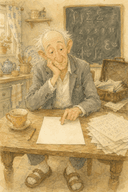
Paul Erdős
No house. No job. No checkbook. Two half-empty suitcases, 1,500 papers, 511 collaborators, and a 4:30 a.m. greeting of "Let n be an integer." Paul Erdős ran on Benzedrine and bar mitzvahs — the homeless prince of twentieth-century mathematics.
🇮🇳India(3)
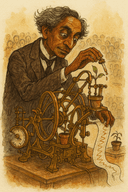
Jagadish Chandra Bose
In 1895, a scientist invented radio components he refused to patent, then built a machine that recorded the exact moment a plant died.
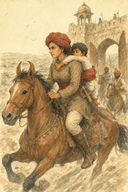
Lakshmibai of Jhansi
Before breakfast: weightlifting, wrestling, steeplechasing. Daily. At 29, with her son strapped to her back, she rode 100 miles, took Gwalior, and died in the saddle in trousers and a turban. The general who killed Rani Lakshmibai filed the verdict.
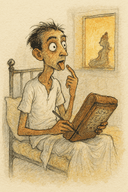
Srinivasa Ramanujan
A goddess wrote equations on his tongue in dreams, and when mathematicians finally checked his work, he was right.
🇮🇪Ireland(3)
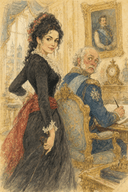
Lola Montez
She horsewhipped a Prussian gendarme, challenged a newspaper editor to a duel with poisoned pills, and raised a private army of law students that toppled a king. Meet Lola Montez: dancer, countess, kingdom-wrecker.

Mary Mallon ("Typhoid Mary")
Her signature was peach ice cream, uncooked, served cold. She chased the sanitary inspector into the street with a carving fork. They confined her on an island, then released her on one condition. Mary Mallon kept her word for five years.
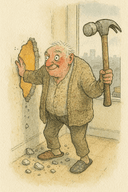
William Lyttle
He dug a wine cellar, found a taste for it, and kept going for forty years. His tunnels ran sixty feet in every direction. The clay had to go somewhere, so it went into the rooms above. William Lyttle: the man who traded his house for a hole.
🇮🇹Italy(5)
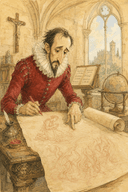
Carlo Gesualdo
He kept ten men on staff to beat him three times a day. One specialist was hired to beat him while he defecated — for constipation, melancholy, and demons at once. Composer, prince, murderer: Carlo Gesualdo's repentance had a finishing touch.
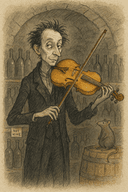
Paganini
His body sat on his deathbed for two months. Then the cellar. Then an abandoned leper house. Then a cement vat in an olive oil factory. The church wouldn't touch him — he'd spent his career letting audiences believe the devil was guiding his bow. Niccolò Paganini, the man who played twelve notes per second and couldn't get a burial plot.
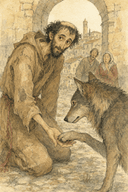
Saint Francis of Assisi
He set out honey for cold bees, moved worms off the road, and asked a red-hot cautery iron to be courteous before it touched his face. Then, in 1220, Francis of Assisi walked out alone to negotiate with the wolf eating the town of Gubbio.
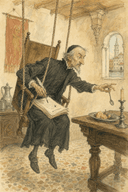
Santorio Santorio
🇯🇲Jamaica(1)
🇯🇵Japan(5)
Hiroo Onoda
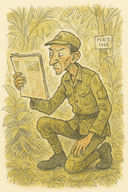
He fought a jungle war for 29 years, alone, convinced the newspapers left for him were enemy propaganda. A 24-year-old found him in four days — the same kid whose to-do list included a panda and the abominable snowman. Hiroo Onoda: the last man the war forgot to tell.

Hokusai
He once dipped a chicken's feet in red paint, chased it across a blue wash, and presented the result to the shōgun as a landscape of the Tatsuta River with autumn leaves. He moved house ninety-three times. He changed his name thirty. The blue that defines his most famous image — the one now considered the most quintessentially Japanese artwork ever made — was smuggled contraband, invented in Berlin, reverse-engineered in Guangzhou. Katsushika Hokusai died at eighty-eight. His tombstone read: Old Man Mad About Painting.

Matsuo Bashō
A bureaucrat quit his job managing pipes, moved into a riverside hut, and named himself after a useless banana tree. Then he wrote seventeen syllables about a frog hitting water — the most translated poem in Japanese history. His name was Matsuo Bashō.
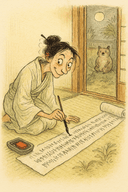
Sei Shōnagon
🇱🇻Latvia(1)
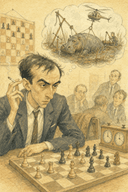
🇲🇱Mali(1)
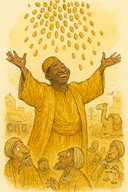
🇲🇽Mexico(1)
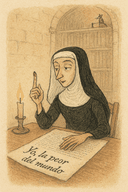
🇲🇦Morocco(1)
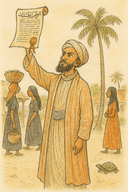
🇳🇱Netherlands(1)
🇳🇴Norway(1)
🇵🇾Paraguay(1)
🇵🇱Poland(1)
🇵🇹Portugal(2)
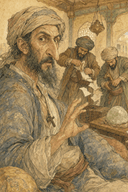
Bento de Goes
He grew a beard, donned a turban, and crossed the Hindu Kush as an Armenian merchant named Servant of Jesus. He bought a jade boulder to fund the road, refused a king's prison or Islam, and reached China on Christmas. Bento de Goes, lay brother.
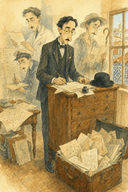
Fernando Pessoa
He translated commercial correspondence by day. By night he was a Horatian classicist, a Glasgow naval engineer, and roughly seventy-three other people, each with their own handwriting and horoscope. Fernando Pessoa, Lisbon's most crowded clerk.
🇷🇺Russia(6)
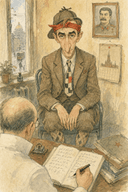
Daniil Kharms
He walked 1930s Leningrad in a deerstalker and spats, carrying a butterfly net. He recited poems from on top of a wardrobe. He prayed, in rotation, for sex, money, and death. Meet Daniil Kharms, children's poet and founder of Russian absurdism.
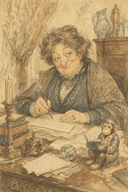
Helena Blavatsky
In 1875 a Manhattan parlor began receiving letters from Tibetan Masters, dropped from the ceiling onto devotees' heads. One hundred and forty-two arrived. Blavatsky kept a stuffed baboon holding Darwin. Every yoga studio owes her its vocabulary.
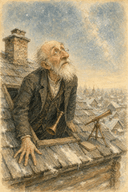
Konstantin Tsiolkovsky
He bought his first bicycle at forty-five. He ice-skated holding an umbrella to catch the wind. A trapdoor in his ceiling opened onto the roof; his family called it the door to outer space. His name was Konstantin Tsiolkovsky.
Sergei Korolev
He put Sputnik in orbit and Gagarin after it. He accepted the Lenin Prize under a pseudonym, because the public was not allowed to know his name. Sergei Korolev: father of the Space Age, ghost of his own century.
🇷🇸Serbia(1)
🇪🇸Spain(2)

Antoni Gaudí
He weighed strings with birdshot, photographed the sag, and flipped the picture to find his church. He carried hazelnuts and one key when the tram hit him. Taxis refused the rags. Antoni Gaudí, the dandy who ended up trusting what falls.
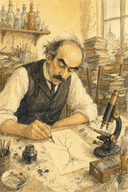
Santiago Ramón y Cajal
He worked twenty-hour shifts at the microscope. He once spent one watching a single white blood cell crawl out of a capillary, until it was out. He produced 2,900 ink drawings of what Santiago Ramón y Cajal called the butterflies of the soul.
🇸🇪Sweden(4)
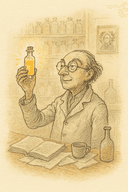
Carl Wilhelm Scheele
A pharmacist working alone in the back rooms of small Swedish towns discovered oxygen, chlorine, manganese, barium, molybdenum, and tungsten — then took so long to publish that better-connected chemists in London and Paris announced the same findings first and received all the credit. His method for identifying new substances was to taste them, including hydrogen cyanide and arsenic. He died at forty-three. Meet Carl Wilhelm Scheele, the most productive chemist of the eighteenth century that history mostly forgot to name.
2 oddlets

Hilma af Klint
A weekly seance. Six spirits with names like Amaliel and Gregor. A commission for 193 canvases, four days each, for a temple never built. Hilma af Klint crated the first abstract paintings in Western art and told the world to wait.

Jenny Lind
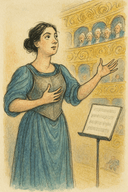
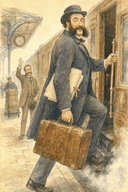
He wrote 'The Nightingale' in a single feverish evening. He handed her the proposal on a train platform; she read it after the train had gone. Her reply called him brother. Then Jenny Lind sailed for America as the Swedish Nightingale.
🇨🇭Switzerland(3)
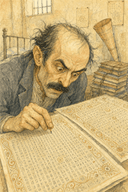
Adolf Wölfli
Admitted to a Bern asylum in 1895, he was rationed one pencil and two sheets of newsprint a week. He used them to crown himself St. Adolf II and run the books on a cosmic empire — 25,000 pages of compounding interest, audited from a cell.
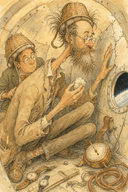
Auguste Piccard
In 1931, two men in fruit-basket helmets sealed themselves in a seven-foot aluminum sphere and rode a hydrogen balloon past 50,000 feet. The valve froze. The hull cracked. Meet Auguste Piccard, Switzerland's tallest contingency planner.
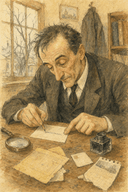
Robert Walser
His hand seized up, so he switched to pencil and shrank his letters to a millimeter. Scholars needed thread counters. They assumed it was code, the script of a madman. It was just German. Robert Walser, the novelist Kafka loved, kept writing anyway.
🇸🇾Syria(1)
🇹🇷Türkiye(2)
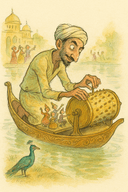
Ismail al-Jazari
In 1206, a mechanical boat floated across a palace lake carrying four robot musicians. The drummer alone performed fifty distinct movements per song — and if you rearranged the pegs, he played a different rhythm. Nobody in the West would build anything like it for seven hundred years. His name was Ismail al-Jazari: the man who engineered wonder as a job requirement.

Kösem Sultan
Stolen from a Greek island at fourteen. Ran an empire for forty-six years from behind a wooden lattice. Signed off on her own son's execution. Kösem Sultan, strangled at sixty-two with a torn-down curtain because protocol forbade silk.
🇬🇧United Kingdom(50)
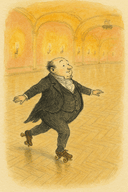
5th Duke of Portland
He dug fifteen miles of tunnels beneath his estate, furnished them with a 250-foot library and a ballroom for ten thousand square feet, and never invited anyone. Servants who crossed his path were required to face the wall. His bedroom door had a letterbox so he'd never have to speak. William John Cavendish-Scott-Bentinck, 5th Duke of Portland — the man who built a world underground and left the one above it strictly alone.
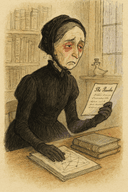
Ada Lovelace
A mother banned poetry from her daughter's life. Filled the house with logic, science, parallelograms. It worked — the girl wrote the first computer program a century early. Then she quietly wrote a sonnet. Ada Lovelace, the Enchantress of Number, buried beside Byron.
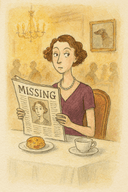
Agatha Christie
A woman vanished. A thousand police searched. Conan Doyle handed her glove to a psychic. She was at a spa, reading newspapers covered in her own face, registered under her husband's mistress's name. Agatha Christie, the one mystery no one got to solve.

Aleister Crowley
🇬🇧United Kingdom(2)
🇺🇸United States(49)
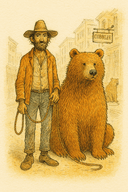
"Grizzly" Adams
He lost his shoe shop, his ranch, and his business partners in quick succession. So he walked into the Sierra Nevada and tamed grizzly bears instead — one carried his pack, one saved his life, one became the model for the California state flag. John "Grizzly" Adams: the cobbler who found his footing in the wilderness.
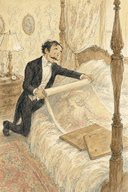
Adam Worth
He stole the Gainsborough to bail out his brother. The brother walked free the next day. He kept her anyway — rolled paint-side out, flattened beneath his Mayfair mattress for twenty-five years. Adam Worth, the Napoleon of crime, called her the Lady.
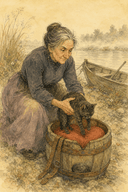
Annie Edson Taylor
In 1901, she strapped herself into a padded oak barrel with an anvil at her feet and went over Horseshoe Falls. She was sixty-three. A charm-school teacher. Broke. And she had already sent the cat. Meet Annie Edson Taylor, Queen of the Mist.
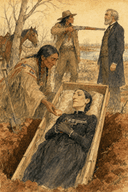
Belle Starr
Shotgunned off her horse two days before her 41st birthday. Suspects: her third husband, her own son, and a Florida fugitive next door. They buried the Bandit Queen in black velvet with a revolver in her hands.