Oddlet: Ibn Battuta · 1 min read
Feb 26, 2026
The Man Who Couldn't Stop Walking
He left home for a sixteen-month pilgrimage and came back twenty-four years later.
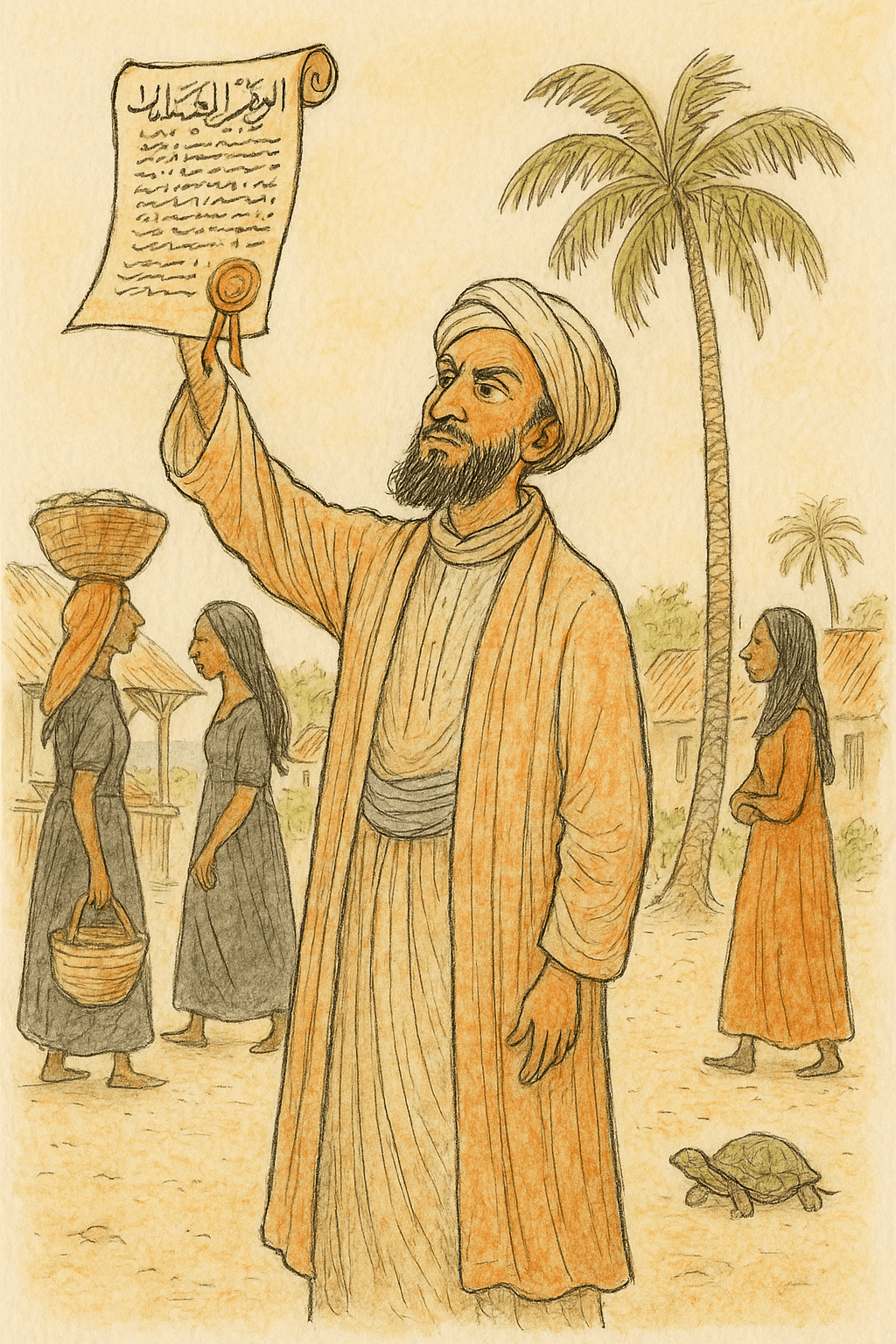
In 1325, a twenty-one-year-old legal scholar named Ibn Battuta left Tangier to make the hajj to Mecca. It should have taken about sixteen months. He didn't come home for twenty-four years.
He just kept going.
He crossed the Sahara. He sailed down the East African coast. He rode through Central Asia, visited Constantinople, trekked the Hindu Kush, served as a judge in Delhi, was shipwrecked off the coast of India, and made it to China. His total distance — roughly seventy-three thousand miles — was about three times what Marco Polo covered. He survived the Black Death in the Middle East and wrote one of the only eyewitness descriptions of it. He was, by any measure, one of the most restless human beings who ever lived.
Eventually the Sultan of the Maldive Islands appointed him qadi — chief Islamic judge. It was, in theory, the kind of prestigious settled post a traveling scholar might dream of. Ibn Battuta took the job and promptly issued a ruling that local women must cover their breasts in public, a practice the Maldivians had never observed and saw no reason to start.
The women ignored him. The entire population, essentially, shrugged.
He lasted eighteen months. Then he left, resumed walking, and didn't stop until he'd crossed the Sahara one more time.
Some people are not meant for staying.
Know someone who’d love this?
- Wikipedia: Ibn Battuta — Comprehensive overview; useful for dates, route, and reception history. Wikipedia synthesizes secondary scholarship but should be cross-checked against primary sources.
- Encyclopaedia Britannica: Ibn Battuta — Peer-reviewed reference entry. Confirms birth year 1304, departure 1325, and the Rihla's compilation circa 1355 with Ibn Juzayy. Notes scholarly debate about whether Ibn Battuta visited all places he described.
- The Travels of Ibn Battuta (Rihla) — Internet Medieval Sourcebook, Fordham University — Excerpts from the Rihla in English translation. Primary source material; useful for direct textual reference.
- Ross Dunn, 'The Adventures of Ibn Battuta' (University of California Press, 1986/2005) — The standard modern scholarly biography in English. Dunn addresses the 73,000-mile estimate and the authenticity debates around sections of the Rihla, particularly the China and Mali accounts.
The Cartwheel Brims
A loom took half her scalp at thirteen; she spent the next eighty-seven years deciding what the world was allowed to see.
The Servant of Jesus
In 1602 the Jesuits sent a former soldier to walk from India to China in disguise to settle a geography argument — what could possibly go wrong?
Peace
He fed three thousand people in an afternoon, banned the word "hello" because it contained "hell," and quietly let his followers know he was God.
Wonder, delivered.
A fresh Oddlet in your inbox every morning, a full day before everyone else. True, strange and under a minute.
Free forever. Unsubscribe anytime.