Oddlet: Charles Babbage · 1 min read
Sep 28, 2026
The Man Who Counted the Hurdy-Gurdies
The man who designed the first computer spent a quarter of his working life fighting street musicians. Guess which project he finished.
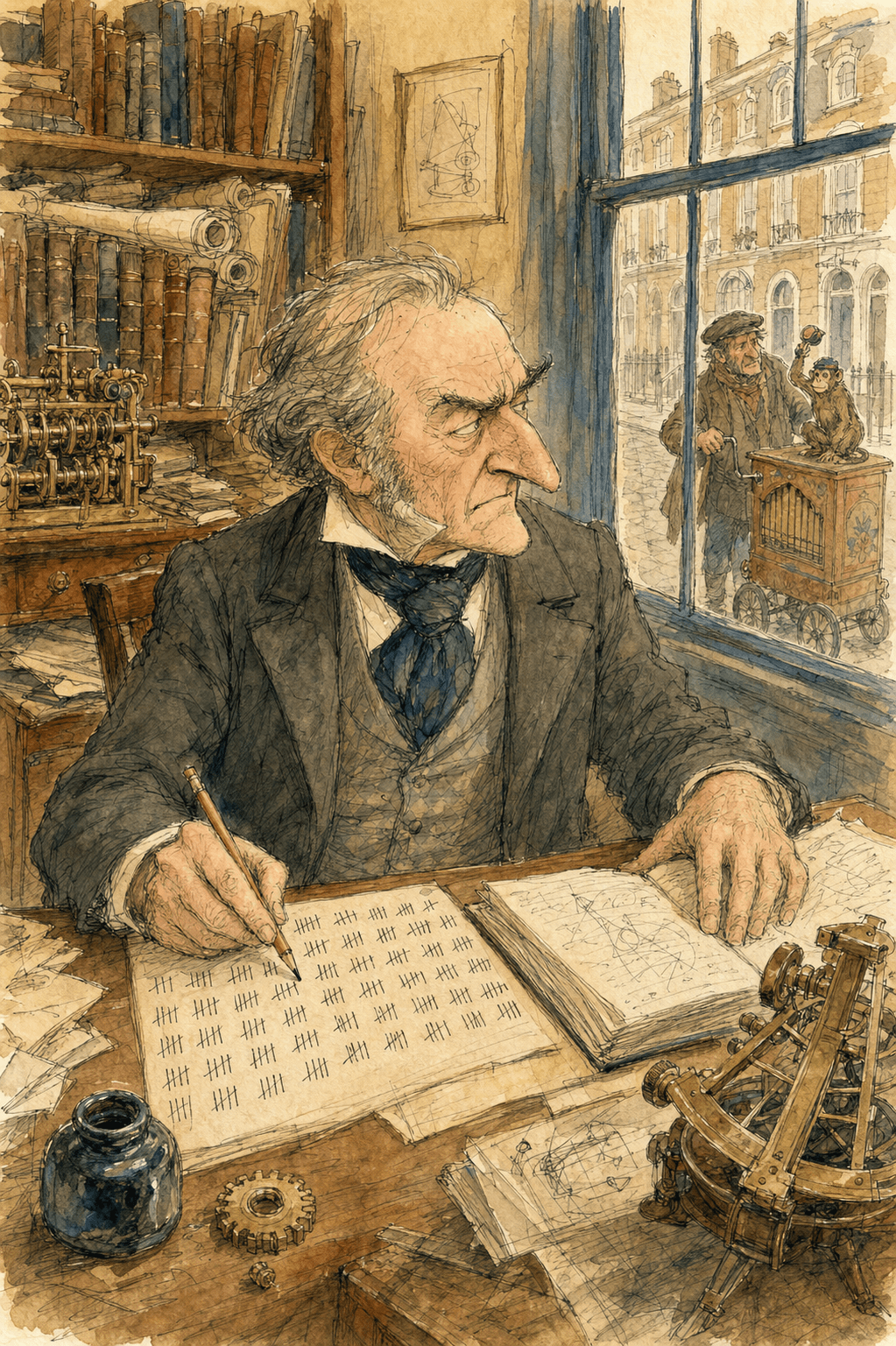
Charles Babbage designed the first computer. The Analytical Engine, drafted in 1837, had a memory, a processor, punched cards, and conditional branching. It would have worked. The British government, having already sunk seventeen thousand pounds into his earlier machine, declined to find out.
So he sat in his study at 1 Dorset Street, Marylebone, and counted hurdy-gurdies.
He kept a tally. Over eighty days he logged one hundred and sixty-five separate interruptions by street musicians, and calculated that a full quarter of his working life had been ground away by organ-grinders, brass bands, halfpenny whistles, tom-toms, and what his list flatly names as "the human voice." He went out himself to stop most of them. In one twelve-month stretch his legal bills came to within a few shillings of one hundred and four pounds. A neighbour blew a tin whistle at his window for half an hour a day for several months. Recovering from surgery one December, he was woken at one in the morning by a brass band that kept playing while he could not move.
What do you do with a mind like that. You publish the tally.
In 1864, in the memoir where he looked back on the general-purpose computer, he devoted a full chapter to the count. He titled it, without irony, "Street Nuisances."
Know someone who’d love this?
- Encyclopedia Britannica — Difference Engine — Overview of Difference Engine construction, £17,000 government funding, Clement dispute, and 1842 abandonment.
- Computer History Museum — The Babbage Engines — Technical specifications: parts counts, dimensions, design dates for DE1, DE2, and Analytical Engine.
- Science Museum (London) — Charles Babbage's Difference Engines and the Science Museum — Modern construction of Difference Engine No. 2 (1985–2002) by Doron Swade's team from Babbage's 1847–49 plans.
- MacTutor History of Mathematics — Babbage biography — Verified biographical dates: Cambridge (1810), Royal Society (1816), Lucasian Chair (1828–39), Analytical Society (1812).
- Standard Ebooks — Passages from the Life of a Philosopher, Ch. XXVI 'Street Nuisances' — Primary source: Babbage's own 1864 text with quotes on organ-grinders, one-fourth lost working power, 165 interruptions in 80 days, dead cats and broken windows.
- Wikipedia — Charles Babbage's Saturday night soirées
The Man Who Refused to Lose a Thought
What does a Victorian mathematician invent when he refuses to lose a single thought to the dark?
The Nanny Who Never Looked
What if one of the twentieth century's great photographers spent her whole life making pictures she never bothered to look at?
The Half-Sovereign
What do you do when the greatest engineer of the Victorian age inhales a gold coin during a magic trick for his children?
Wonder, delivered.
A fresh Oddlet in your inbox every morning, a full day before everyone else. True, strange and under a minute.
Free forever. Unsubscribe anytime.