Oddlet: Diogenes of Sinope · 1 min read
Mar 1, 2026 · Updated Mar 2, 2026
The Man Who Plucked the Chicken
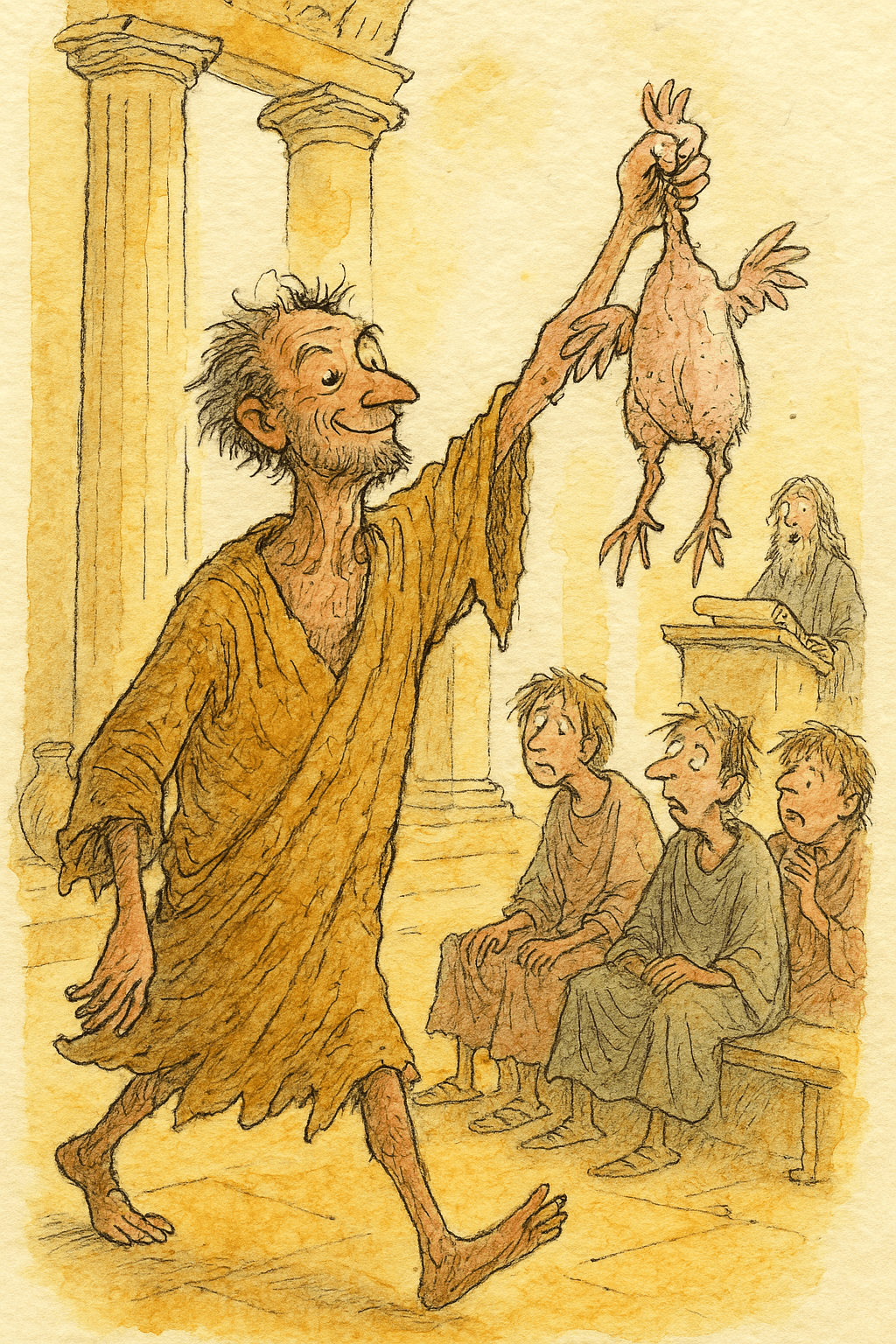
Plato defined a human being as a featherless biped, and someone showed up with a chicken.
Diogenes of Sinope was one of the most influential philosophers in the ancient world. He founded Cynicism, shaped centuries of thought about virtue and self-sufficiency, and attracted the personal attention of Alexander the Great, who once visited and offered to grant him anything he desired. Diogenes, sunbathing at the time, asked Alexander to move because he was blocking the light.
He owned almost nothing. He lived in a large ceramic jar in Athens. He carried a lamp through the streets in broad daylight, claiming to be looking for an honest man. He performed every bodily function in public — all of them — on the philosophical grounds that anything natural required no shame. When people objected, he objected to their objecting.
He was, by any measure, a man committed to his project.
But his masterpiece was a chicken.
The story goes that Plato, riding high on the admiration of his students, had produced a definition of a human being: a featherless biped. The Academy was delighted with this. It was clean, logical, elegant.
Diogenes plucked a chicken, walked into Plato's lecture, threw the naked bird on the floor, and announced: "Here is Plato's man."
Plato was forced to revise his definition. The new version added the phrase "with broad, flat nails."
It is perhaps the only time in the history of philosophy that a chicken won the argument.
Know someone who’d love this?
- Wikipedia: Diogenes — Good synthesis of ancient sources; secondary source only. Dates and anecdotes flagged as uncertain where ancient accounts conflict.
- Diogenes Laërtius, Lives of the Eminent Philosophers, Book VI — Primary ancient source for most Diogenes anecdotes, written c. 3rd century AD — roughly 500 years after Diogenes lived. Reliability is disputed; many stories are likely apocryphal or embellished.
- Plutarch, Life of Alexander, 14 — Source for the Alexander sunlight encounter. Plutarch wrote c. 100 AD, ~400 years after the event; historicity uncertain but widely accepted as culturally significant.
- Stanford Encyclopedia of Philosophy: Cynics — Scholarly overview of Cynic philosophy and Diogenes' role as its central figure. Discusses the difficulty of separating historical Diogenes from legendary accretion.

The Formosan
How did a blonde Frenchman convince 1700s London he was from Formosa?
Present But Not Voting
What kind of man spends sixty-three years perfecting the instructions for his own stuffed body?

The Rope
What do you call a woman who wouldn't cross the lawn for Emerson, but rigged a rope from her window for children she refused to greet at the door?
Wonder, delivered.
A fresh Oddlet in your inbox every morning, a full day before everyone else. True, strange and under a minute.
Free forever. Unsubscribe anytime.