Oddlet: Lewis Carroll · 1 min read
Sep 19, 2026
The Man Who Refused to Lose a Thought
What does a Victorian mathematician invent when he refuses to lose a single thought to the dark?
Charles Dodgson lectured on Euclid at Christ Church for twenty-six years, wrote Alice in his spare time, and climbed to a glasshouse on the roof of Tom Quad to photograph Tennyson, Faraday, Rossetti, and Ellen Terry. A first-class mathematician at the top of Victorian intellectual life.
He was also, quietly, at war with forgetting.
For thirty-seven years he kept a register of every letter he sent and received, cross-indexed, numbered, tallied. At his death the final entry read 98,721. He published a pamphlet explaining the system, in case anyone else wished to run one.
Sleep offered no reprieve. An insomniac, he lay in the dark and composed and solved seventy-two mathematical problems in his head, then wrote them up in the morning. He said it kept his mind from wandering into "skeptical thoughts, which seem for the moment to uproot the firmest faith." Mathematics, apparently, was cheaper than a night-light.
That left one loophole. Ideas that arrived after the candle was out.
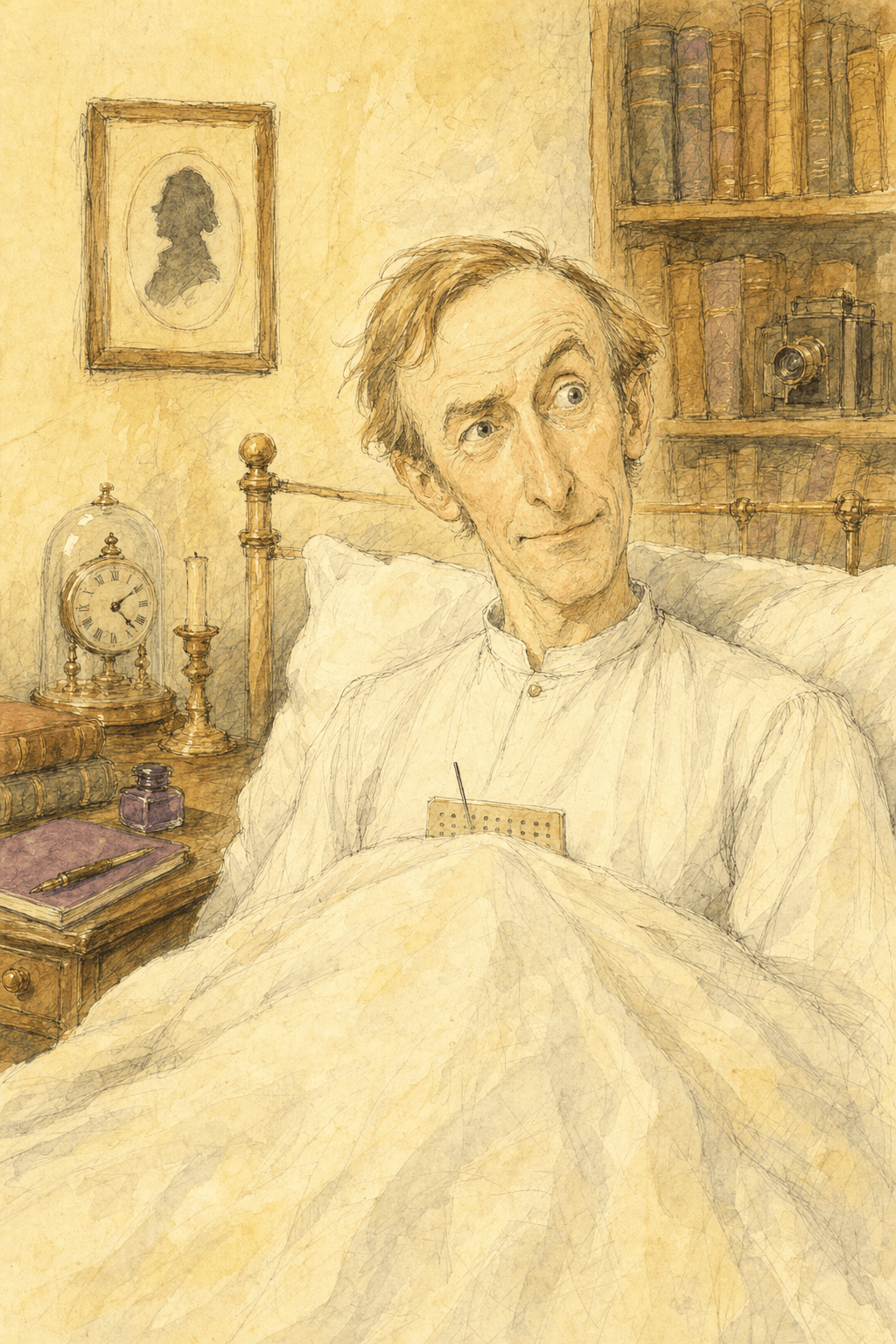
In 1891 he closed it. He designed a gridded card with sixteen quarter-inch square holes and an alphabet of dots and strokes, so he could write in bed, in total darkness, without lifting his hands from under the bedclothes.
He called it the nyctograph. Greek for writing in the dark.
Know someone who’d love this?
- Wikipedia — Lewis Carroll — Comprehensive biographical overview: dates, Christ Church career, works, photography (1856–1880, ~3,000 images), inventions, personal habits.
- Internet Encyclopedia of Philosophy — Lewis Carroll: Logic — Details of his logic publications (The Game of Logic 1887, Symbolic Logic Part I 1896), the Tree Method (1894), and his Mind articles on the Barbershop Paradox and Tortoise/Achilles.
- Wikipedia — Nyctography — Covers the 1891 invention of the nyctograph, the 16-hole gridded card, and the alphabet of dots and strokes Carroll designed for writing in the dark. Originally named 'typhlograph.'
- The Lancet — Mirror writing: Allen's self observations, Lewis Carroll's 'looking-glass' letters, and Leonardo da Vinci's maps — Academic analysis of Carroll's mirror-writing habits, citing the 24 November 1883 letter to Daisy Brough as an example.
- Encyclopaedia Britannica — Lewis Carroll — Standard reference biography confirming birth/death dates, Christ Church career, mathematical lectureship, and the Alice books.
- The Marginalian — Carroll's Rules of Letter-Writing
The Nanny Who Never Looked
What if one of the twentieth century's great photographers spent her whole life making pictures she never bothered to look at?
The Half-Sovereign
What do you do when the greatest engineer of the Victorian age inhales a gold coin during a magic trick for his children?
The Man Who Chased His Own Equation
What do you do when the blackboard you've been chalking equations onto turns out to be a moving cab?
Wonder, delivered.
A fresh Oddlet in your inbox every morning, a full day before everyone else. True, strange and under a minute.
Free forever. Unsubscribe anytime.