Oddlet: Julian of Norwich · 1 min read
Apr 4, 2026
The Woman Who Wrote From Inside a Wall
A bishop sealed her inside a stone room, and she stayed for forty years — then T.S. Eliot quoted her during the Blitz.
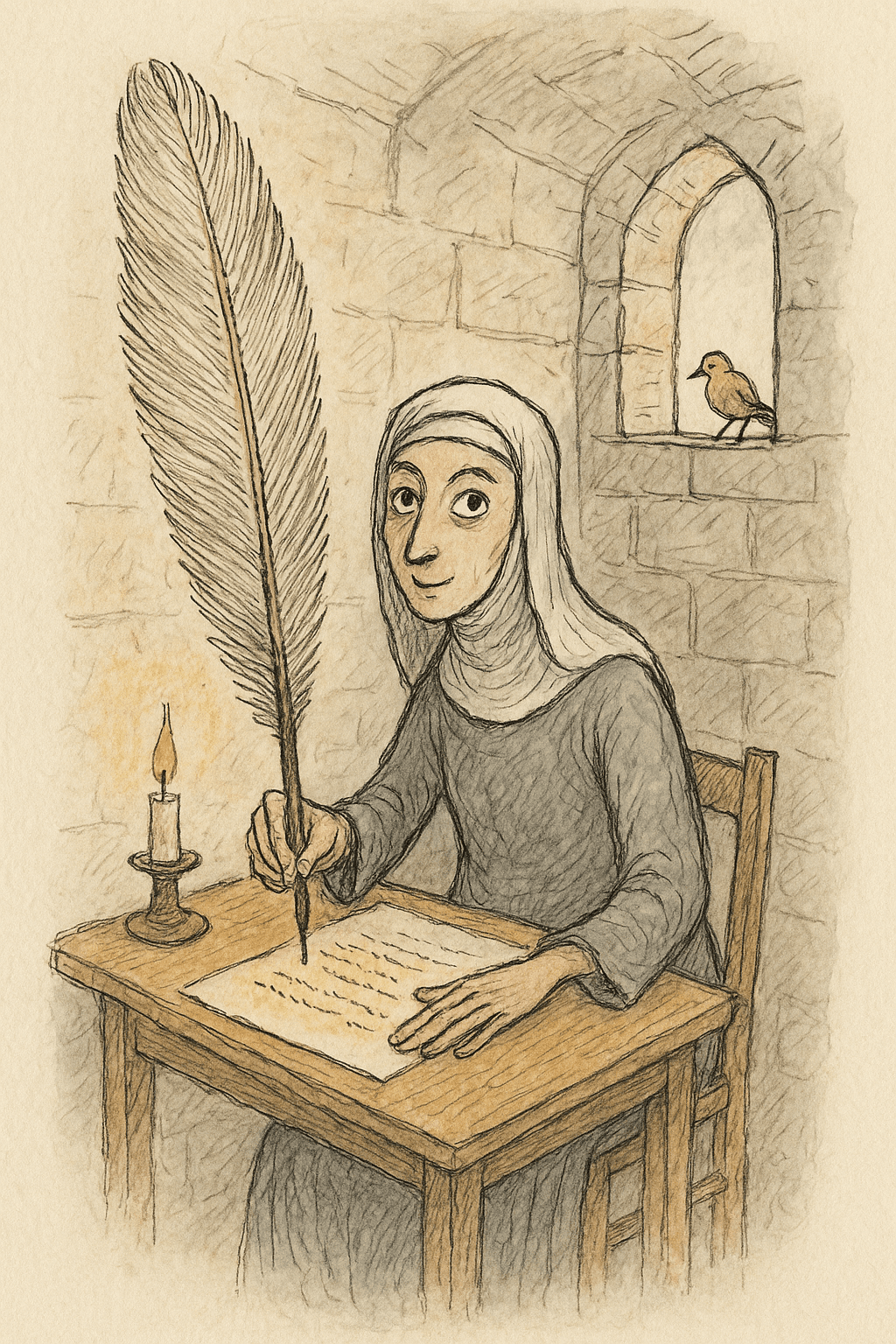
Sometime around 1373, a woman in Norwich had a funeral sung over her while she was alive. Then a bishop led her into a small stone room attached to the side of a church, and the door was sealed shut behind her.
She would not leave for the next forty years.
The enclosure ceremony for a medieval anchoress followed the Office of the Dead. Once inside, you were finished with the world. Your cell — roughly a hundred square feet — had three windows: one for communion, one for your servants, and one through which you could speak to visitors. That was it. That was your life.
From this room, the woman we call Julian of Norwich wrote Revelations of Divine Love, the first book in English known to have been authored by a woman. We don't even know her real name; she probably took "Julian" from the church her cell was attached to. She spent twenty years meditating on a series of visions, then wrote them down with a calm, luminous certainty that still startles people who open the book expecting medieval gloom. Her most famous line: "All shall be well, and all shall be well, and all manner of things shall be well."
In 1942, with bombs falling on London, T.S. Eliot reached for those words to close Four Quartets.
He quoted her three times.
Know someone who’d love this?
- Wikipedia — Julian of Norwich — Comprehensive, well-cited overview; cross-checked against primary sources. Reliable for biographical facts and manuscript history.
- Wikipedia — Revelations of Divine Love — Detailed article on the text's manuscript tradition and publication history. Reliable.
- Britannica — Julian of Norwich — Authoritative encyclopaedia entry; good for dates and theological context.
- World History Encyclopedia — Peer-reviewed, well-sourced; useful for social context and Margery Kempe connection.
- Friends of Julian of Norwich — Official charity site; reliable for devotional and biographical summary, though not a scholarly source.
- CBE International — Useful for cell dimensions and daily life detail; secondary source, treat with care.
The Hermit Who Kept Office Hours
What kind of hermit hires two armed guards, then hands out gin to two hundred children through the bars of his window?
The Friar Who Kept Flying
What happens when a monk so incompetent he nearly wasn't ordained starts doing something no one can explain or contain?
The Man Who Let Gravity Draw
What kind of architect designs a church by hanging it upside down from a shed ceiling?
Wonder, delivered.
A fresh Oddlet in your inbox every morning, a full day before everyone else. True, strange and under a minute.
Free forever. Unsubscribe anytime.