Oddlet: Daphne Oram · 1 min read
Jun 29, 2026
The Woman Who Drew Sound
She quit the BBC Radiophonic Workshop within months of founding it, because the hearing-protection rule was applied only to her.
In 1958, Daphne Oram co-founded the BBC Radiophonic Workshop, the room where, four years later, the Doctor Who theme would be assembled. She had spent her teens as a BBC studio engineer, perched under the dome of the Royal Albert Hall during the 1944 Proms, ready to drop the needle on a matching 78 the instant a doodlebug forced the orchestra to flee, so German listening posts wouldn't hear the broadcast skip. She had turned down the Royal College of Music for the job.
She quit within months. The BBC had decided that electronic-music staff could only stay three months, to protect their hearing. The rule was applied only to her.
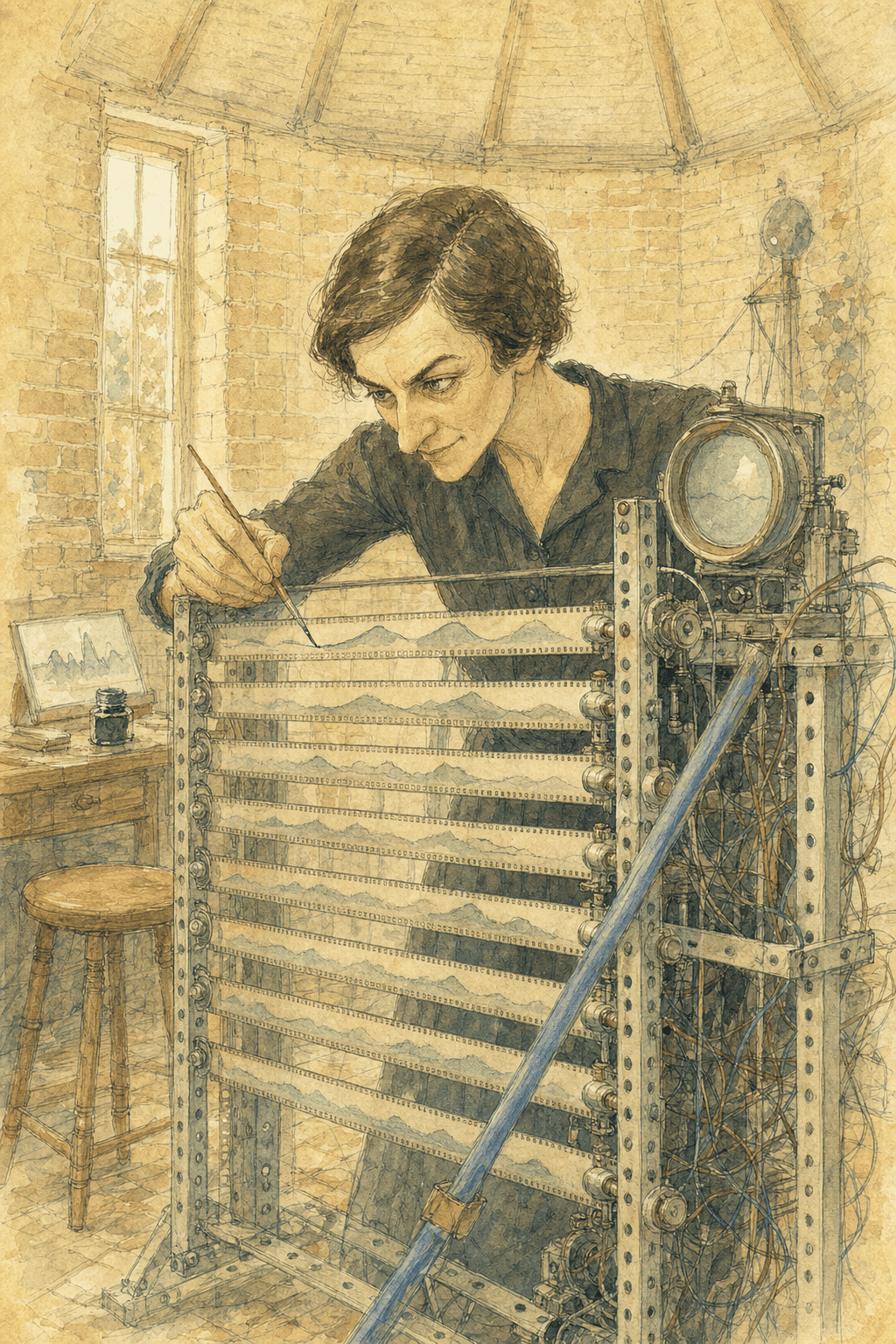
She moved to a converted oasthouse in Kent called Tower Folly — circular, conical-roofed, festooned with windows at different heights, as if drawn by someone who had heard about houses but never seen one — and named her cats Elect, Tronic, Sine and Square, and her two goats Deci and Bell. In the octagonal studio at the base, she and her brother built a machine the size of a photocopier out of Dexion shelving, ten loops of 35mm film, hand-wound ferrite rings, transistors with the paint scraped off, and a blue broom handle holding part of it together.
You painted a shape on the film. The machine sang the shape.
Know someone who’d love this?
- Wikipedia: Daphne Oram — Comprehensive biographical overview: birth (31 Dec 1925, Devizes) and death (5 Jan 2003, Maidstone), BBC career from 1942, co-founding of Radiophonic Workshop with Desmond Briscoe in 1958, resignation 1959, Tower Folly studio, Oramics development, compositions, book, and legacy honours.
- Daphne Oram Trust — Brief Biography — Official biography maintained by the Daphne Oram Trust; details family background, Sherborne education, 1942 BBC entry, Amphitryon 38 (1957) as first wholly electronic BBC score, Gulbenkian grants (£3,550 in Feb 1962; £1,000 in 1965), Still Point first performance 24 June 2016, and the Oram Awards / Canterbury Christ Church building.
- Daphne Oram Trust — The Oramics Machine — Technical description of the Oramics machine: conceived mid-1950s, designed 1957, prototype funded 1962, working prototype 1966, operational 1966–1973; details the 10 35mm film strips, photoelectric cells, glass slides, four CRTs, and patented sawtooth oscillator; confirms machine is now in the Science Museum's permanent collection.
- Science Museum Group Collection — Oramics Machine (object 2010-68) — Museum catalogue record for the Oramics Machine, dated 1966; lists designer Daphne Oram, mechanics by John Oram, electronics by Fred Wood and Graham Wrench; describes 10 parallel 35mm filmstrips and waveform glass slides.
- Wikipedia: Oramics
The Toothbrush at Holloway
She trained Emmeline Pankhurst to throw rocks under a fir tree at twilight, and the first one flew backwards.
Play a Strawberry
Who feeds a band one cup of soybeans a day for a month and calls it rehearsal?
The Rubber Man
The man who invented vulcanized rubber spent $30,000 he didn't have to build a palace of rubber furniture inside a building made of glass.
Wonder, delivered.
A fresh Oddlet in your inbox every morning, a full day before everyone else. True, strange and under a minute.
Free forever. Unsubscribe anytime.