Oddlet: Carl Wilhelm Scheele · 1 min read
Mar 4, 2026
The Chemist Who Tasted Everything
He discovered oxygen two years before the man history credits with discovering oxygen.
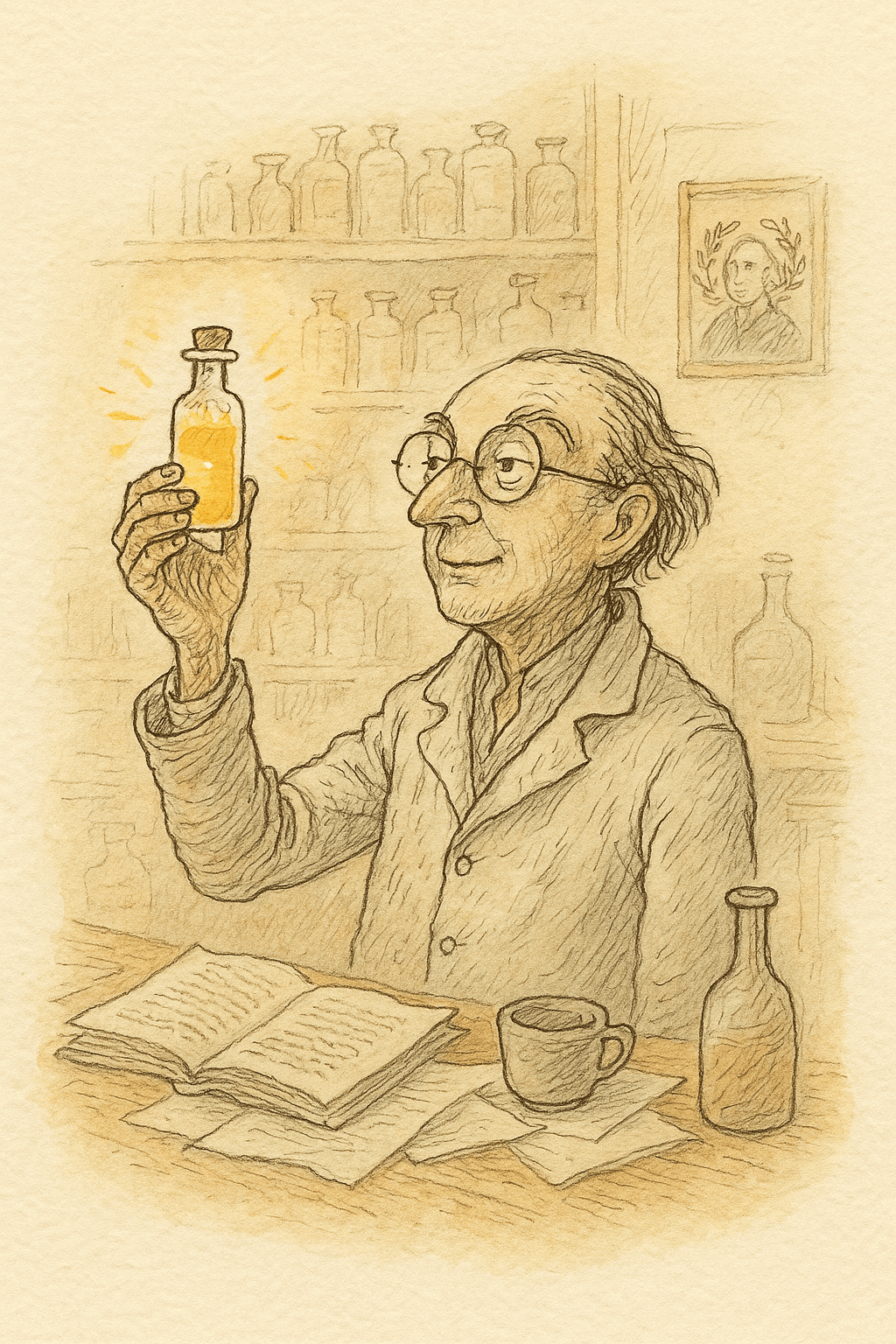
Carl Wilhelm Scheele discovered oxygen. He also discovered chlorine, manganese, barium, molybdenum, and tungsten. He isolated citric acid, lactic acid, and glycerol. Working alone in the back rooms of Swedish pharmacies with homemade equipment, he made more chemical discoveries than virtually anyone in the eighteenth century.
Almost none of them are named after him.
Scheele had a problem: he was catastrophically bad at publishing his results. He'd discover something extraordinary, then take years to write it up, by which time some better-connected chemist in London or Paris would announce the same finding and receive all the credit. He discovered oxygen two years before Joseph Priestley, but his book arrived at the printer late. He identified element after element but couldn't be bothered with the politics, so others got the honors. He was elected to the Royal Swedish Academy of Sciences and reportedly attended exactly one meeting.
He had another problem, too. Scheele's method for identifying a new substance was to taste it. Hydrogen cyanide, arsenic, mercury, lead — he noted their flavors the way a sommelier might describe a wine. He once described prussic acid as having "a peculiar, not unpleasant smell."
He turned down offers from Berlin and London, preferring his small pharmacy in Köping, population roughly one thousand. He died there at forty-three, two days after a deathbed wedding arranged so his landlady could inherit his estate. His body was, by that point, a museum of his own discoveries.
The one thing that does bear his name is Scheele's Green — a gorgeous pigment he invented from arsenic that took Victorian Europe by storm.
It may have killed Napoleon.
Know someone who’d love this?
- Wikipedia: Carl Wilhelm Scheele — Comprehensive overview of discoveries, timeline of oxygen priority dispute, tasting habits, death date, and marriage. Wikipedia synthesizes secondary sources; individual claims should be verified against primary literature for publication.
- Royal Society of Chemistry: Carl Scheele — RSC profile confirming Scheele's discovery of chlorine, manganese, and multiple organic acids, and his status as an apothecary rather than an academic chemist. Notes the oxygen priority question.
- Britannica: Carl Wilhelm Scheele — Confirms birth date (9 December 1742, Stralsund), death date (21 May 1786, Köping), list of discovered substances, and notes his practice of tasting chemicals. States he 'suffered from ill health' in later years, consistent with poisoning hypothesis.
- Chemical Heritage Foundation / Science History Institute: Scheele — Discusses the oxygen priority dispute with Priestley and Lavoisier, Scheele's publication delay, and his working conditions in Swedish pharmacies. Useful for framing the credit-loss narrative accurately.

Paint Sacred Art
What does a 59-year-old Baptist preacher do when a face appears in a smudge of paint on his fingertip and tells him to start painting?

The Man Who Would Not Be Seen
What does the richest man in America do when a photographer finally catches him on the street at age 80?

Monsieur Le Blanc
What do you do when you're convinced Napoleon's army is about to kill your pen pal mid-proof?
Wonder, delivered.
A fresh Oddlet in your inbox every morning, a full day before everyone else. True, strange and under a minute.
Free forever. Unsubscribe anytime.